
Have you ever stayed in an Airbnb? Sold your clothes through a site like Poshmark? Rented a parking space? Or maybe you hired someone to help you hang a TV.
That’s all part of the sharing economy, a peer-to-peer economic model that allows people to make money from their underused assets (think: resources, goods, time, knowledge and skills) through online platforms. Even freelance work could be considered part of this sector.
What started as a grassroots movement has blossomed into a full-fledged economic force. And many have already discovered the benefits of the sharing economy, using it to supplement their income, pursue their passions and reclaim their financial freedom.
But how did this come about? Let’s unpack just how the sharing economy works, how it grew and where it’s headed next.
Key Takeaways
- The sharing economy lets individuals earn money from underused assets like cars, homes and even time and skills through peer-to-peer digital platforms like Airbnb, Uber, DoorDash and TaskRabbit.
- The sharing economy grew rapidly after the 2008 financial crisis and again during COVID-19, as people sought flexible income and cost-saving alternatives.
- Regulation is shaping the future of the sharing economy, with governments introducing laws around worker classification, housing, safety and data transparency.
- Getting started in the sharing economy is easier than ever, and platforms like KashKick can help users earn bonuses when signing up for side gigs.
What is the Sharing Economy?
The sharing economy, which is sometimes called the collaborative or gig economy, is a decentralized model where individuals share or exchange goods, services and resources through digital platforms.
The idea is simple: Rather than buying something you’ll infrequently use, you can either rent or borrow it from someone who already owns it.
Unlike traditional business models—where companies own assets and deliver services—the sharing economy allows people to rent out what they already own. This can include cars, homes or skills.
Likewise, it enables people and communities to share or access goods, services and resources. This is often facilitated through digital platforms and peer-to-peer interactions.
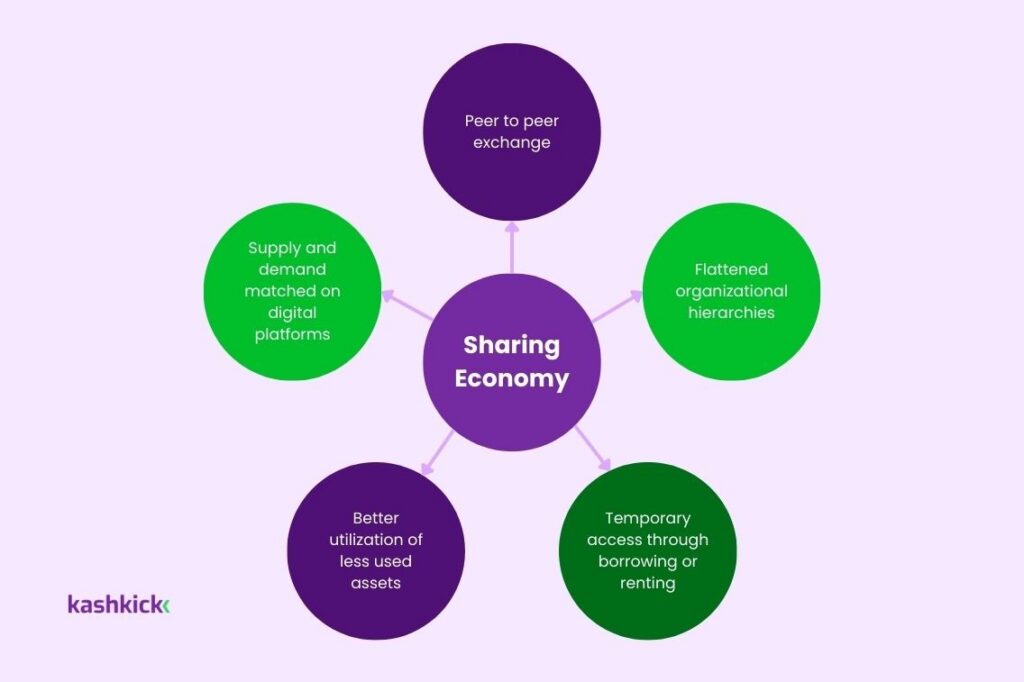
Key characteristics of the sharing economy include:
- Access over ownership: Rather than owning assets outright, people can access goods and services on an as-needed basis, often through rental or subscription models.
- Peer-to-peer transactions: The sharing economy leverages technology to enable direct exchanges between individuals, cutting out traditional middlemen.
- Efficient utilization of resources: The sharing economy aims to maximize the utilization of underused assets, creating value from previously idle resources.
- Community-driven platforms: Sharing economy businesses often build their models around online communities and user-generated content, fostering a sense of connection and trust.
- Technology-driven platforms: Companies like Uber, Airbnb and TaskRabbit serve as intermediaries, matching users with providers.
- Trust and reputation systems: The success of the sharing economy relies heavily on trust. To build confidence, platforms incorporate ratings, reviews and verification processes.
- Flexibility: Users can access goods or services on demand without the long-term commitment of ownership.
Origin and Evolution of the Sharing Economy
The sharing economy, while often viewed as a more modern innovation, is rooted in age-old practices of collaboration and resource-sharing.
Historically, communities depended on barter systems and the informal exchange of goods and services. These systems allowed people to share what they had—whether it was food, tools or labor—in return for what they needed.
This form of sharing thrived in smaller, more tightly-knit communities where relationships were built on trust and reciprocity. For example, farmers might share machinery during harvest seasons, or neighbors might exchange skills like carpentry for food.
As the world shifted toward industrialization, communal sharing systems became less common, replaced by formal businesses and institutions that owned and sold goods and services.
The idea of individual ownership and the traditional market economy took hold, and sharing became more of a personal or familial activity rather than a community-wide practice.
The Inception of Modern Sharing Platforms
The concept of the sharing economy as we know it today was fundamentally transformed with the rise of the digital age. The development of the internet and mobile technology reformed how people could connect and exchange goods and services globally.
The birth of e-commerce platforms in the 1990s, such as eBay, showed early signs of a growing interest in peer-to-peer (P2P) exchange, as people started selling secondhand goods online.
However, the real turning point came after the 2008 global financial crisis, when economic challenges spurred a renewed interest in cost-saving measures and alternative forms of income.
During this period, people struggled to maintain their standard of living and began seeking more flexible ways to supplement their income. At the same time, consumers were growing more skeptical of large institutions, which had played a central role in the economic downturn. This led to a cultural shift toward valuing access over ownership—why own a car when you can simply rent one when needed?
In 2008, Airbnb officially launched as a platform that allows people to rent out spare rooms or their homes to travelers, offering a more affordable alternative to hotels.
At the time, the idea of staying in a stranger’s home seemed unconventional, but it quickly gained traction, particularly during the recession when homeowners were looking to make extra money—and travelers were looking for cheaper alternatives.
Uber, founded in 2009, introduced a similar model, allowing people to use their own cars to provide rides for others.
Instead of owning a fleet of vehicles, Uber transformed everyday individuals into drivers for hire. These platforms were the first in a series of digital companies that would turn ordinary people into part-time entrepreneurs.
The rise of smartphones and GPS technology further accelerated the growth of the sharing economy. Mobile apps enabled instantaneous connections between consumers and service providers, allowing for seamless, on-demand transactions.
For example, riders could hail a car in minutes with Uber, while travelers could book a last-minute stay with Airbnb. The level of convenience and immediacy was unprecedented, and it played a huge role in the widespread adoption of sharing economy platforms.
By 2015, the sharing economy had taken off, particularly in sectors like transportation, accommodation and gig work.
Freelance platforms like Fiverr and Upwork allowed people to monetize their skills at their own pace, while services like TaskRabbit provided a marketplace for everyday tasks like furniture assembly or running errands.
According to PwC, by 2013, the sharing economy was valued at $15 billion—but this was just the beginning.
Impact of COVID-19 on the Sharing Economy
While the sharing economy had been growing steadily, the pandemic had a profound impact—both positive and negative—on its evolution.
Certain sectors, like travel and accommodation, were hit hard as global lockdowns and restrictions grounded flights and closed borders. Airbnb, for instance, saw its bookings plummet in 2020 as tourism came to a halt.
However, side hustle platforms related to gig work, food delivery and remote freelancing experienced unprecedented demand during the pandemic. And as people stayed home, services like DoorDash, Instacart and Postmates became essential for getting groceries and meals delivered.
In fact, the demand for food delivery services surged during the pandemic. Similarly, gig platforms like Fiverr and Upwork experienced a spike in demand as companies shifted to remote work and sought freelance talent to fill gaps in their operations.
According to a survey by Davinci Pyments, gig work participation in the U.S. grew by 33% between 2020 and 2021, with many people using these platforms as a way to supplement their income during economic uncertainty. Over 2.1 million gig workers had entered the gig economy by the end of 2020.
One of the most important factors that enabled the sharing economy to flourish was the development of trust mechanisms on digital platforms. When you’re getting into a stranger’s car or staying in someone’s home, trust is important.
Platforms like Uber and Airbnb introduced ratings and review systems to foster trust between users. After every ride or stay, users are asked to rate their experience, leaving both positive and negative feedback that others can view. Transparency like this helped build a sense of accountability and security, making the sharing economy more reliable to a wider audience.
Regulatory Evolution and Legal Challenges
As the sharing economy evolved from an informal, community-driven idea into a tech-fueled global phenomenon, it became clear that regulations designed for traditional businesses didn’t always apply.
Early platforms like Uber and Airbnb operated in a legal gray area, often bypassing existing regulations for taxis, hotels and employment. This allowed them to scale quickly, but it also attracted scrutiny from governments and competitors in traditional industries.
Initially, regulators struggled to keep up. By 2010, major cities like New York, San Francisco and London began clashing with sharing economy platforms over issues like zoning laws, safety standards and worker rights.
For example, Uber faced backlash from taxi unions that argued the platform’s drivers were operating illegally, without licenses required for professional drivers. Likewise, Airbnb hosts were often in violation of local housing or zoning laws, leading to lawsuits and regulatory crackdowns in popular tourist cities.
However, this regulatory pushback also marked an important evolutionary stage for the sharing economy. Over time, governments worldwide began to adopt laws and introduce frameworks that allowed platforms to operate more transparently. In some cases, platforms themselves introduced self-regulation mechanisms to improve safety and compliance, such as background checks for Uber drivers or insurance coverage for Airbnb hosts.
A few significant milestones in this regulatory evolution include:
- In 2017, the European Court of Justice ruled that Uber operates as a transport service and must comply with local taxi regulations.
- In 2019, California’s Assembly Bill 5 (AB-5) sought to classify gig workers like Uber drivers as employees, not independent contractors, to ensure they received labor protections such as minimum wage and benefits.
- In 2019, Airbnb agreed to share data on its listings with New York City to help enforce local rental laws following legal disputes.
- In 2023, New York passed a law (Local Law 18) restricting short-term rentals in certain areas to limit Airbnb’s impact on housing shortages.
Regulatory adaptations signal a maturation of the sharing economy. What started as a disruptive and largely unregulated movement has evolved into a more structured industry that balances innovation with legal oversight.
How to Get Started in the Sharing Economy
If you’re interested in joining the sharing economy, all the platforms out there make it easy to get started. But before you do, head over to KashKick. If you’re not yet a member, create a free account in minutes—then explore all the ways you can make extra money.
KashKick isn’t considered part of the sharing economy—but you can sign up for a side gig through the app or website and earn a bonus. Just head over to “Deals” then filter to “Side Gigs.”
Here are a few examples:
- Become a DoorDash delivery driver. Complete your first delivery, and KashKick will give you a $100 bonus.
- Or, sign up to deliver food through Uber Eats, make your first delivery and get a $25 bonus from KashKick.
KashKick is always adding more deals, so keep an eye out for the latest! It’s a great way to get started with a side hustle and earn a little bonus for it!
Conclusion
As the sharing economy continues to grow, we’re likely to see even more innovation as new platforms and technologies emerge, making sharing even easier and more impactful.
The sharing economy offers a future where resources are maximized, industries are disrupted, and individuals have more control over their time and income. What are we getting from this shift? A world where collaboration, flexibility and sustainability are the cornerstones of everyday life.
FAQs on the Sharing Economy
What is the sharing economy in simple terms?
The sharing economy is a system where people make money by renting out or sharing things they already own—like cars, homes or even skills—through online platforms instead of traditional businesses.
What are examples of sharing economy companies?
Common examples of sharing economy platforms include Airbnb (home rentals), Uber and Lyft (ride-sharing), DoorDash and Instacart (delivery services), and Fiverr or Upwork (freelance work).
How can beginners get started in the sharing economy?
Beginners can start by signing up for a reputable platform that matches their skills or assets. Some websites, like KashKick, also offer bonuses for joining certain side gigs, making it easier to earn extra cash early on.